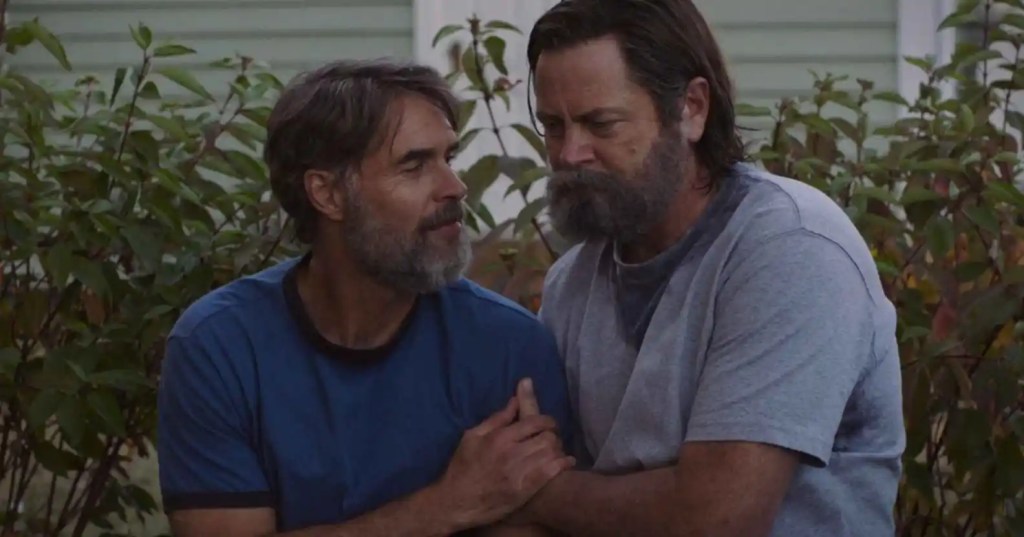
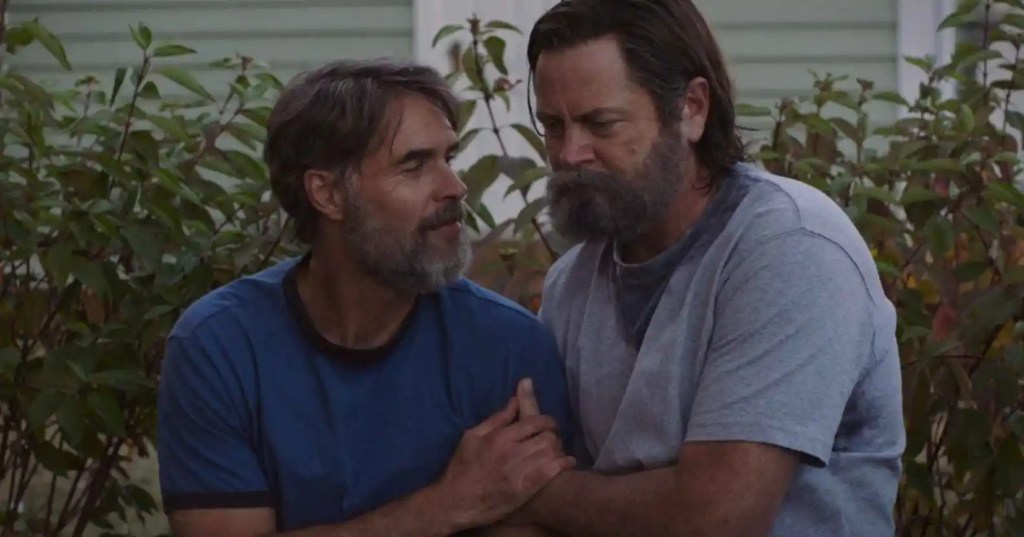
HBO’s new adaptation of The Last of Us digs deep to reimagine the story of Bill and Frank – and in doing so, subverts a longstanding pop culture trope, writes PinkNews’ entertainment editor Christobel Hastings.
If television’s new Golden Age is proving anything right now, it’s that quiet small screen moments are very often the most powerful. Take HBO’s new series The Last of Us, which is currently producing plot twists so shocking, they’re becoming worldwide talking points within hours of airing. Forget swarms of scarlet-eyed monsters and writhing bodies in dark alleyways: in this hellscape, a mass of fungal tendrils unfurling from a corpse’s mouth is infinitely more horrifying than the undead feasting on human flesh.
Based on the landmark 2013 video game, Craig Mazin and Neil Druckmann’s new adaptation is set twenty years after a parasitic outbreak has infected the human race and turned most of the world’s population into zombie-like monsters. In the midst of it all is Joel (Pedro Pascal), a smuggler tasked with escorting Ellie (Bella Ramsey), a teenager seemingly immune to the virus that has toppled the world order, across a post-apocalyptic United States. In the past two episodes, we’ve witnessed the fall of civilisation, devastating loss, and an existential question that is arguably harder to stomach than a mutant fungus bursting forth from a body: carrying on when the unthinkable happens.
But everyone in The Last of Us is living on borrowed time, and this is at the forefront of our minds as we continue the journey in episode three, Long Long Time. Following Tess’ plea to “set everything right, all the shit we did” before making a last stand against a stream of Cordyceps-infected, we now verge away from Joel and Ellie’s quest to reach the western outpost of the resistance movement known as the Fireflies, travelling back in time to explore the story of Bill (Nick Offerman) and his partner Frank (Murray Bartlett).
Read the full feature here.
 CHRISTOBEL HASTINGS